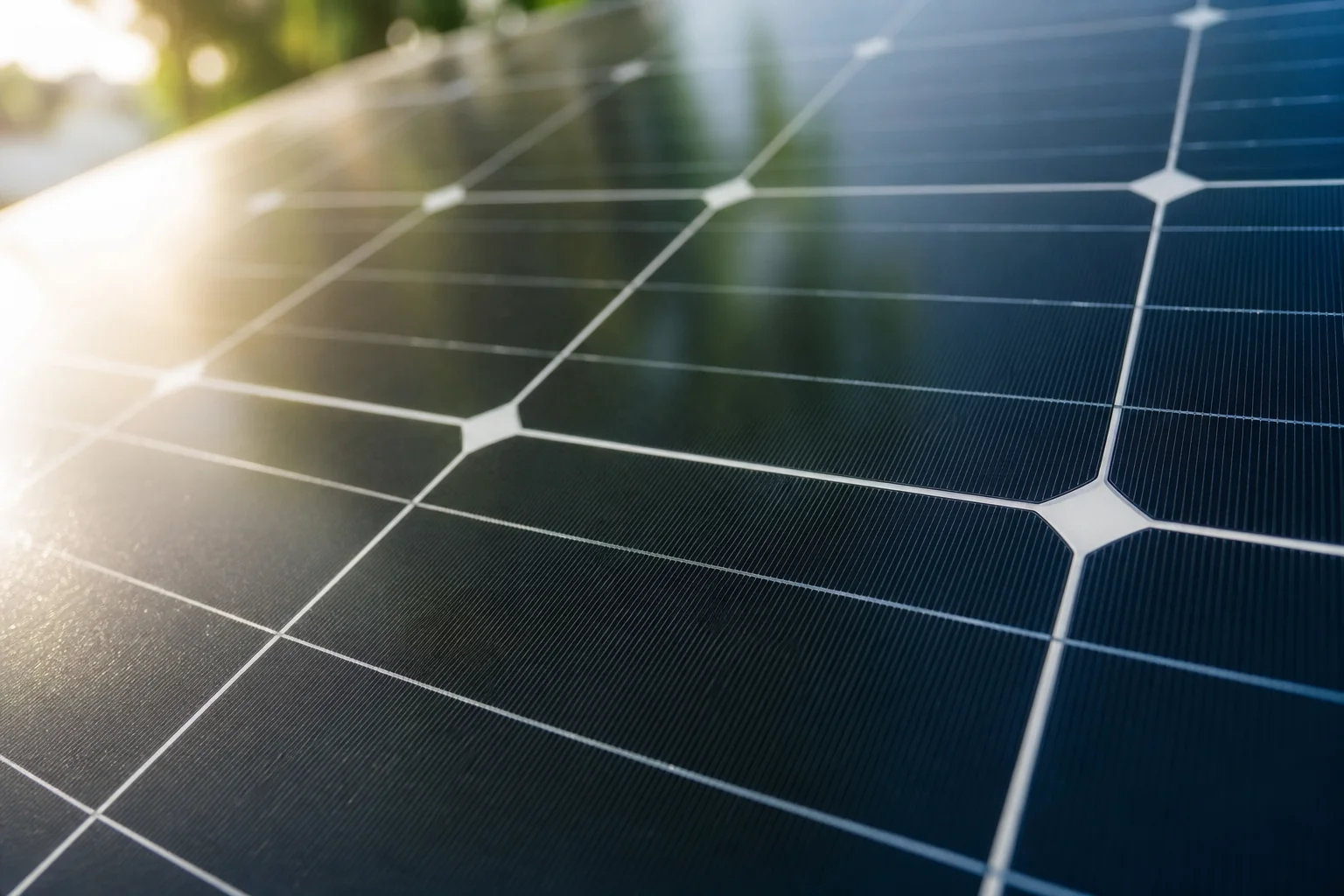
Sunlight hits your roof, and inside a solar panel, that light knocks electrons loose in a silicon wafer, creating a flow of direct current (DC) electricity. An inverter then converts that DC power into the alternating current (AC) your fridge, lights, and pump actually use. That’s how do solar panels work at home in one sentence, and the rest of this guide breaks down each step without the technical jargon.
| Component | What It Does | Typical Detail for a Kerala Home |
|---|---|---|
| Solar Panels | Convert sunlight into DC electricity | Monocrystalline, 8-14 panels for a 3-5 kW system |
| Inverter | Converts DC to usable AC power | String, hybrid, or off-grid depending on setup |
| Net Meter | Records power imported from and exported to KSEB | Installed by the electricity board after commissioning |
| Battery (optional) | Stores excess solar for use during outages | Only needed in hybrid or off-grid systems |
| Mounting Structure | Holds panels at the correct angle on the roof | Usually tilted 10-15 degrees for Kerala’s latitude |
| System Size | Determines how much electricity you generate daily | 3-5 kW covers most 3-bedroom households |
| Roof Space Needed | Area required to mount the panels | Roughly 350-500 sq. ft. for a 5 kW system |
Most homeowners in Kerala have seen solar panels on a neighbor’s roof, but few can explain what actually happens between the sun and the light switch. It’s a short chain with four main stops: the panel, the inverter, the meter, and finally your home’s wiring. Once you understand each stop, the whole system stops feeling like a mystery box and starts looking like straightforward, well-engineered plumbing for electrons.
This matters because a lot of confusion (and a lot of complaints about high electricity bills after going solar) comes from not understanding this chain. Once you know where the power goes and how it’s measured, you can size your system correctly and set realistic expectations about savings.
A solar panel is made of many small silicon cells wired together. When sunlight (specifically, photons) strikes the silicon, it excites electrons and pushes them into motion. That movement is electricity, but it flows in one direction only, which is called direct current, or DC.
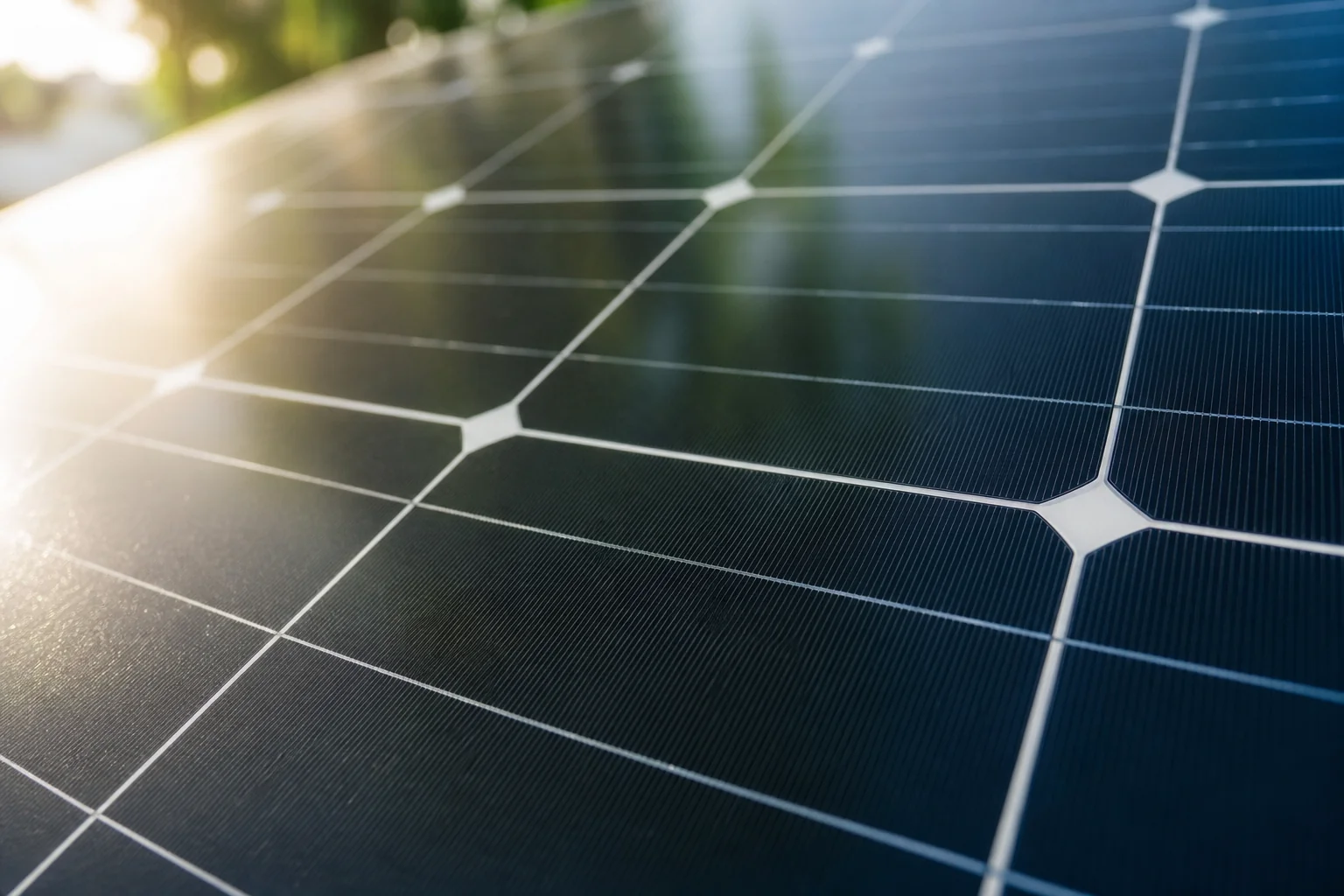
Most residential installations in Kerala today use monocrystalline panels because they perform better in the state’s humid, partly cloudy climate and take up less roof space per kilowatt than older polycrystalline options. If you want the deeper breakdown of panel technologies, it helps to understand the differences before comparing quotes from installers.
A common question homeowners ask is what happens during Kerala’s long monsoon stretch. Panels don’t stop working under clouds; they simply generate less. Diffused sunlight still carries enough energy to produce a meaningful amount of power, just at 20-50% of peak output depending on cloud thickness. Total blackout-level generation only happens at night.
Here’s the catch: nothing in your house runs on DC. Your ceiling fan, refrigerator, television, and water pump are all built for alternating current (AC), the same type of power that comes from KSEB’s grid. The inverter is the translator that sits between your panels and your switchboard, converting DC into clean, usable AC.
There are three broad inverter categories homeowners run into:
Choosing the wrong inverter type is one of the most expensive mistakes homeowners make, especially with hybrid units where sizing and battery compatibility need careful matching to your daily load.
Once your inverter produces AC power, it flows straight into your home’s wiring and powers whatever is switched on at that moment: lights, pumps, the washing machine. Any extra electricity you’re not using gets pushed out to the KSEB grid. This is where the net meter comes in.
A net meter is a bi-directional meter that tracks two numbers separately: how much power you pulled from the grid (import) and how much surplus solar you sent back (export). At the end of the billing cycle, KSEB nets these two figures against each other, and you’re billed only for the difference.
This is also the source of a very common frustration. If your electricity bill is still high after installing solar, the issue is rarely the panels themselves. It’s usually a mismatch between when you generate power (daytime) and when you consume the most (evenings), or a system that was undersized against actual household load. Understanding the net meter is the key to understanding your bill.
Batteries aren’t required for solar to work, but they solve a specific problem: what happens when the sun goes down or the grid goes out. Kerala sees its share of power cuts, especially during monsoon storms, and a battery-backed hybrid system keeps essential loads running when a purely grid-tied system would go dark.
In a hybrid setup, surplus solar charges the battery during the day instead of only being exported. That stored energy is then available at night or during an outage, which is often the deciding factor for homeowners choosing between system types.
These three configurations answer the same underlying question differently: how much do you rely on the grid, and do you want battery backup?
| Feature | On-Grid | Off-Grid | Hybrid |
|---|---|---|---|
| Works with KSEB connection | Yes, required | No, fully independent | Yes, plus battery backup |
| Battery included | No | Yes, essential | Yes |
| Power during grid outage | No (auto shuts off) | Yes | Yes |
| Relative upfront cost | Lowest | Highest per kW | Moderate to high |
| Best for | Homes with reliable grid, focused on bill reduction | Shops or homes with no electricity board connection | Homes wanting savings plus backup during power cuts |
Most Kerala homeowners we speak with lean toward hybrid systems, largely because of frequent monsoon-related outages. If you’re comparing which setup actually performs best for your area’s power cut frequency, it’s worth digging into the specifics before finalizing.
System size depends on your average daily electricity consumption, not just the number of rooms in your house. That said, a common benchmark for a 3-bedroom Kerala home with typical fans, lights, a refrigerator, and occasional AC use is a 3-5 kW system.
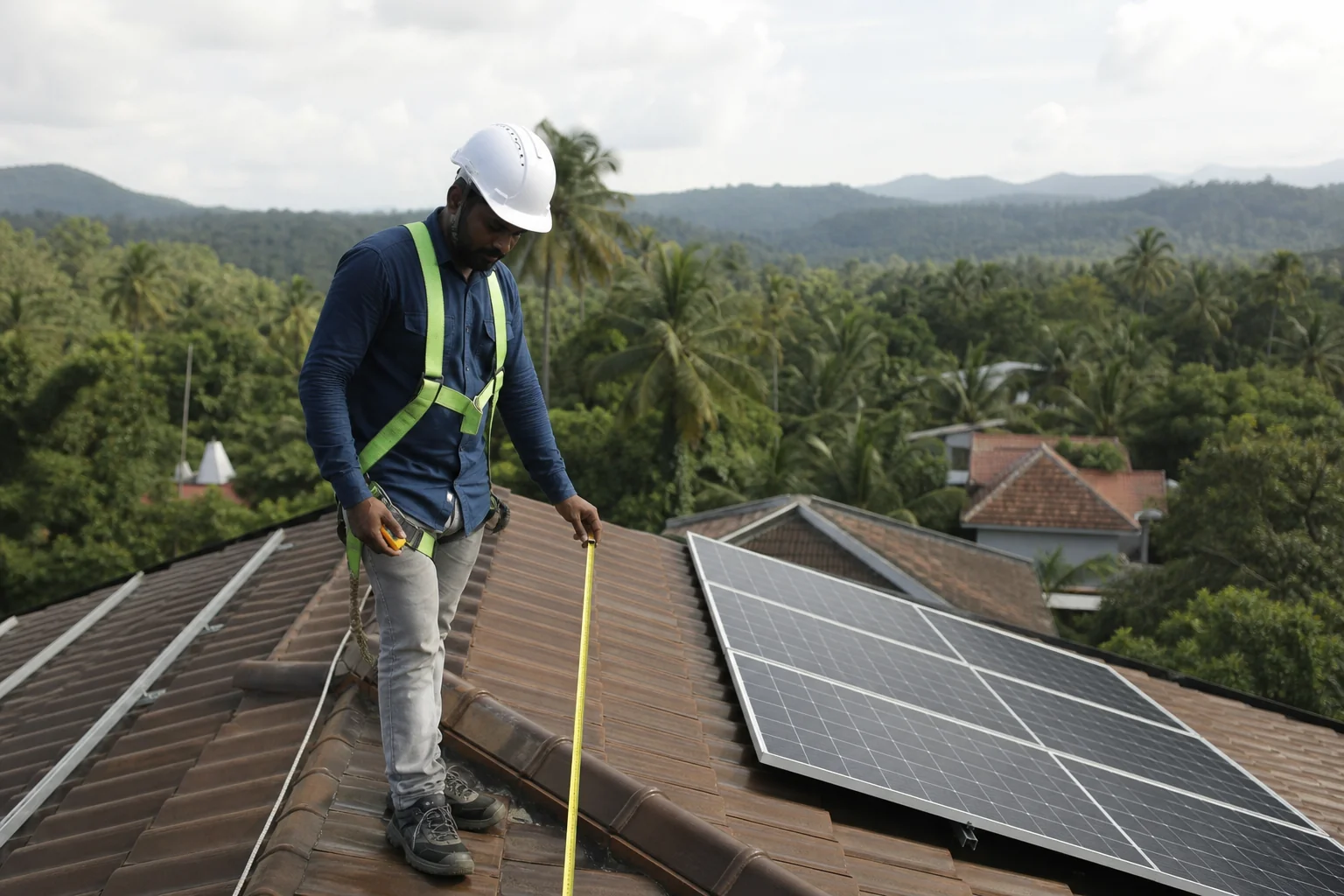
Roof space is the other constraint. A 5 kW system generally needs 350-500 square feet of shadow-free roof area, depending on panel wattage and the tilt structure used. If your roof is partially shaded by trees or neighboring buildings for part of the day, that will affect both sizing and panel placement.
Rather than guessing, it’s far more accurate to run your actual monthly electricity bill through a proper sizing tool. Solar Connect’s Solar Calculator lets you estimate the system size and potential savings for your specific consumption pattern in a few minutes.
Once you know roughly what size system fits your home, the practical part begins: a site visit to assess your roof’s orientation and shading, a formal system design, paperwork for any applicable subsidy, and finally installation and commissioning with KSEB. Each of these stages has its own set of requirements and typical timelines, and getting them right the first time avoids costly delays later.
This is also where working with an experienced local installer pays off. A team familiar with Kerala’s roof types, monsoon patterns, and KSEB’s net metering process can flag issues (like insufficient roof strength or shading from a neighbor’s coconut tree) before they become expensive surprises mid-installation.
Yes, though at reduced output. Diffused sunlight during monsoon or overcast conditions still generates electricity, typically 20-50% of peak capacity depending on cloud density. Panels only produce zero output at night.
No, panels need sunlight to generate electricity. At night, your home draws power from the grid (on-grid systems) or from stored battery power (hybrid and off-grid systems).
Most manufacturers, including Waaree, offer performance warranties of 25 years, with panels typically still producing 80% or more of their original output at that point. According to the Ministry of New and Renewable Energy (MNRE), rooftop solar systems in India are designed for a 25-year operational life when properly maintained.
They need periodic cleaning to remove dust and coastal salt residue, which is more frequent near Kerala’s coastline, plus an annual check of wiring and inverter performance. Beyond that, panels have no moving parts and require minimal upkeep.
Not always. A well-sized system can offset most of your consumption, but bills can still show charges if your usage pattern doesn’t align with generation hours, or if the system was undersized for your household’s actual load.
Understanding each stage of the solar chain, from panel to inverter to net meter, is the single best way to set realistic expectations before you invest in a rooftop system.
If you’re a homeowner in Kerala trying to figure out whether your roof, budget, and electricity usage make sense for solar, the best next step is getting numbers specific to your home rather than general estimates. Try the Know Your Savings tool to see an estimate based on your actual bill, or reach out directly for a site assessment. Get a free quote from Solar Connect’s team, who work across Kerala and South India, and turn this explanation into an actual plan for your rooftop.
Ask ten specific questions before you sign anything, and you'll know within minutes whether a solar installer is worth your rooftop. The questions to ask solar installer before signing contract...
My cousin in Kollam once got two solar quotes on the same day: one from a national brand's call centre, one from a Trivandrum-based crew that had already wired half his street. The loca...
A commercial energy audit before solar installation tells you exactly how much power your business actually uses, when it uses it, and where it leaks money, before anyone quotes you a panel cou...
© 2026 SOLAR CONNECT, All rights reserved. Developed by Crantia Technologies

