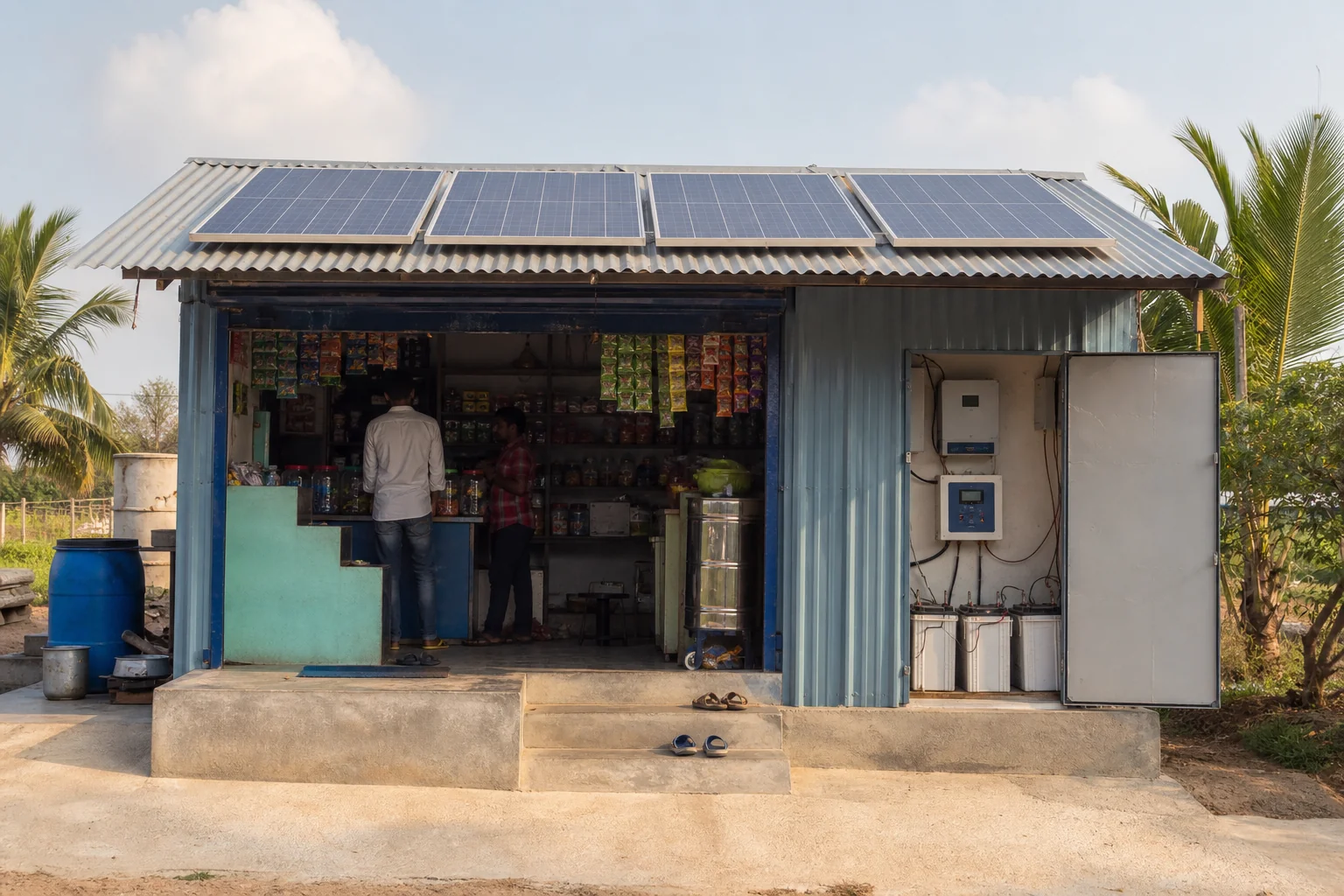
A shop owner in Kollam without an electricity board connection needs a completely different setup than a homeowner in Trivandrum who just wants a lower KSEB bill. The short answer: pick an on grid solar system for the lowest cost and fastest payback when your grid is stable, an off grid solar system when you have no EB connection at all, and a hybrid solar system when you want both bill savings and backup power during outages.
| Factor | On Grid | Off Grid | Hybrid |
|---|---|---|---|
| Grid connection | Required | None | Required |
| Battery included | No | Yes (large bank) | Yes (moderate size) |
| Works during power cut | No | Yes, always | Yes, on backup loads |
| Relative cost per kW | Lowest | Highest | Moderate to high |
| Subsidy eligible | Yes (net metering) | Usually no | Yes (net metering) |
| Best for | Stable KSEB areas | Shops/land with no EB line | Frequent outage zones |
| Payback period (approx.) | 4-6 years | 7-10 years | 5-8 years |
Choosing between these three isn’t just a technical decision. It shapes your monthly KSEB bill, your protection during outages, and how much you spend upfront. Homeowners across Thiruvananthapuram and the wider Kerala service area ask us this question daily, so let’s break down exactly how each system works before comparing them head to head.
An on grid solar system, also called a grid-tied system, connects directly to the KSEB power line through a bidirectional meter. Solar panels generate electricity during the day, and any surplus you don’t consume flows back into the grid under net metering. At night or when your usage exceeds generation, you draw power back from KSEB as usual.
This is the simplest and cheapest configuration because there’s no battery to buy or maintain. It’s the system most homeowners in stable-grid parts of Kerala choose to cut their high electricity bill without a large upfront investment. If you’re new to how the panels themselves generate power, our guide on how solar panels work at home covers the basics.
The catch: on grid systems shut off automatically during a power cut. This isn’t a flaw, it’s a safety requirement so your system doesn’t send electricity into lines that KSEB technicians may be repairing. If your area has frequent or long outages, this blind spot matters a lot.
An off grid solar system operates completely independent of the KSEB network. Panels charge a battery bank, and an inverter supplies power to your home or shop directly from that battery, with no grid connection at all. This is the go-to choice for properties that genuinely have no electricity board line nearby, a common situation we cover in detail in our piece on off grid solar for shops without an EB connection.
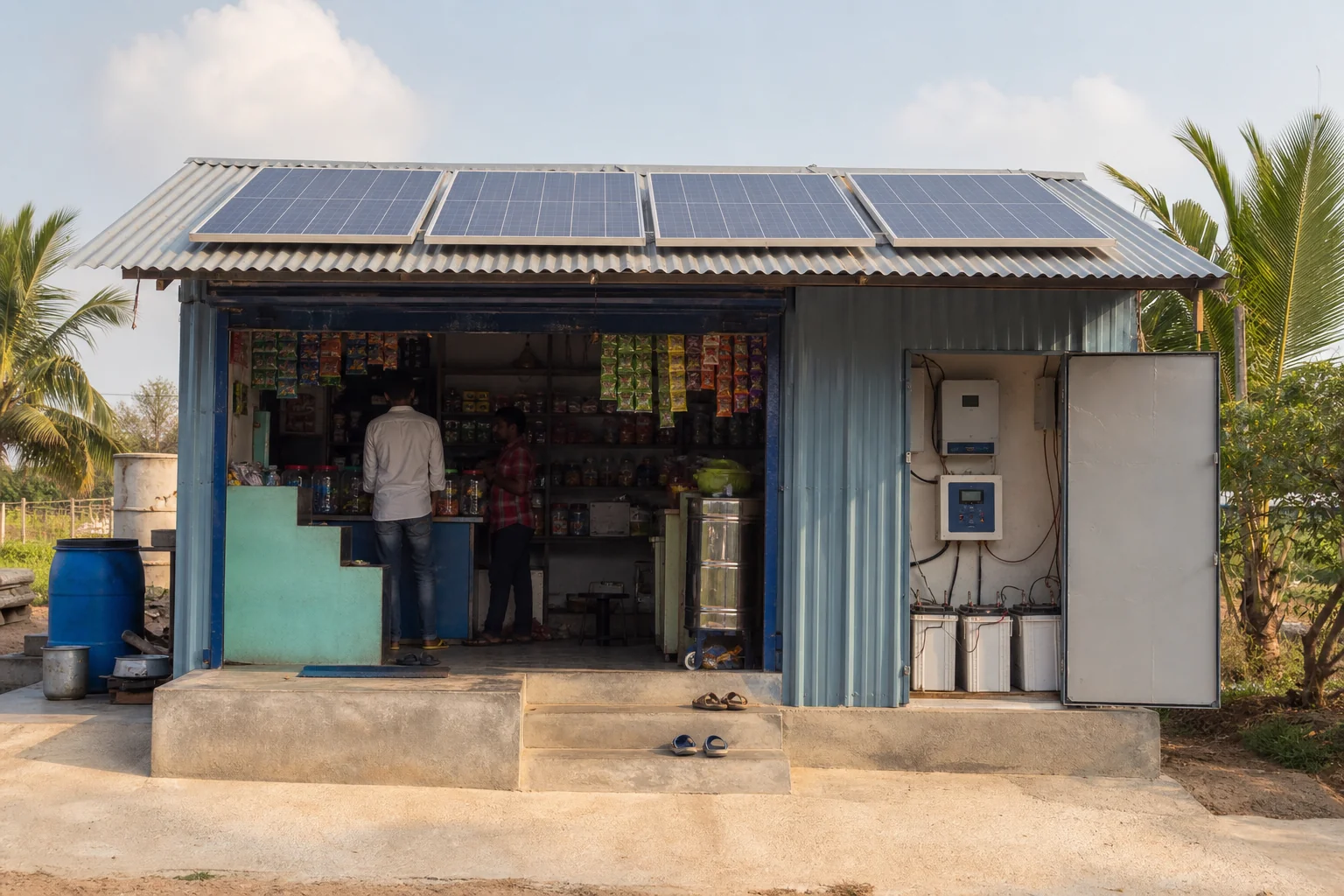
Because the battery bank must cover your entire daily consumption, not just a few backup hours, off grid systems need significantly more storage capacity than hybrid setups. That pushes the price up. They also don’t qualify for KSEB net metering or, in most cases, the PM Surya Ghar subsidy, since those schemes are built around grid-tied systems. For land parcels, farms, or shops still waiting on an EB connection, though, off grid is often the only practical path to reliable power.
A hybrid solar system gives you the best of both. It stays connected to the KSEB grid for net metering and subsidy eligibility, while also including a battery bank that automatically kicks in during a power cut. The hybrid inverter constantly monitors grid status and switches your essential loads, lights, fans, refrigerator, Wi-Fi router, to battery power within milliseconds of an outage.
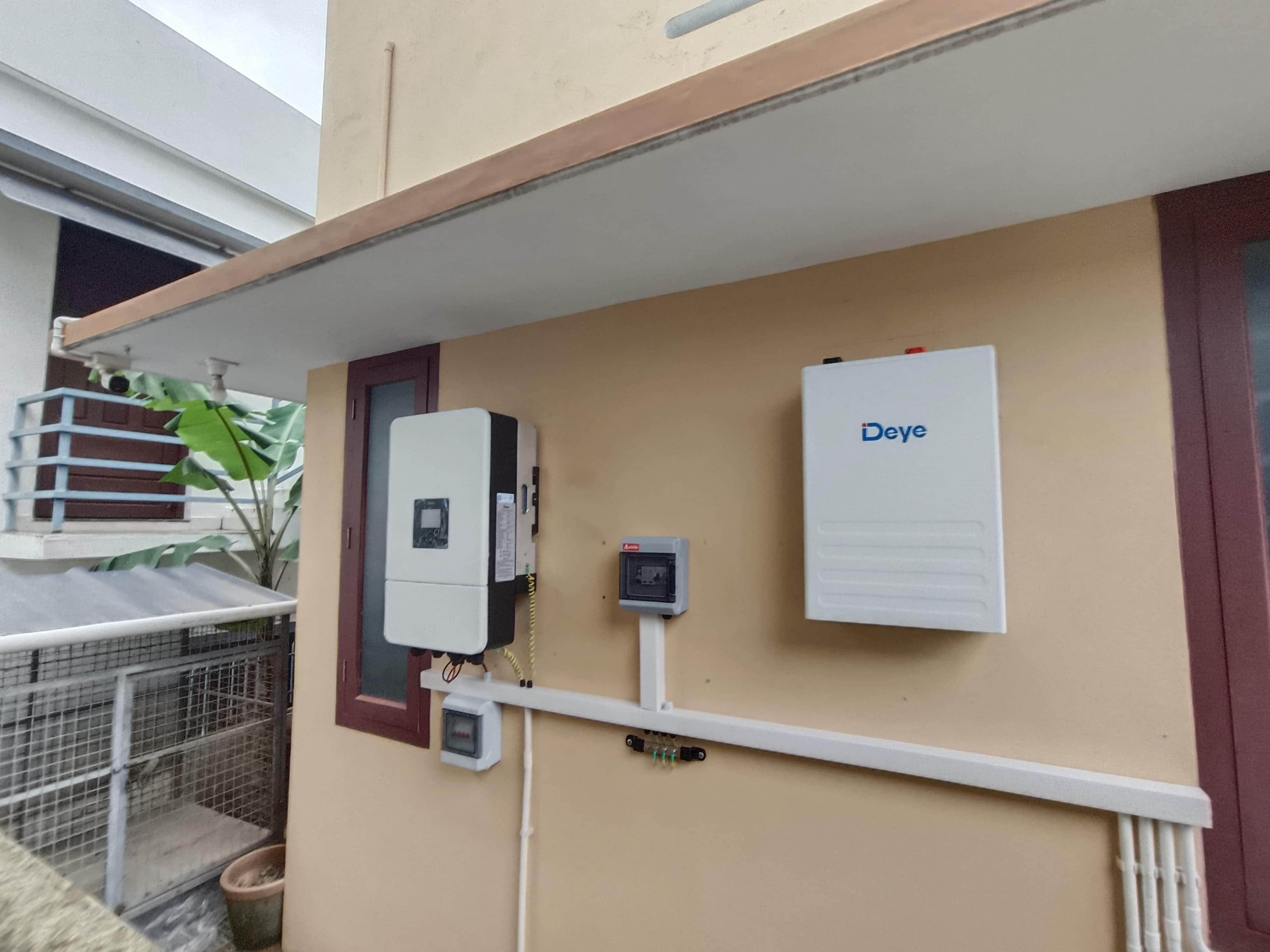
This makes hybrid the preferred choice for homes and businesses dealing with Kerala’s monsoon-season outages or voltage fluctuations. It’s also the system type buyers most often get wrong on sizing and inverter selection. Before you commit, read through common mistakes when choosing a hybrid solar inverter so you don’t overpay for battery capacity you’ll rarely use, or undersize it and end up disappointed during a long outage.
Hybrid systems cost more than on grid because of the battery and a more sophisticated inverter, but less than a full off grid setup since the battery only needs to cover backup hours, not your entire daily load.
Cost is usually the deciding factor, so it helps to see where the money actually goes. For a typical residential setup, our 5kW solar system price breakdown for India shows panels and inverter make up most of an on grid system’s cost. Add a battery bank and that equation shifts sharply.
Use Solar Connect’s free Solar Calculator to run your own numbers against your actual KSEB tariff slab before deciding. If you want the full method behind these numbers, see our guide on how to calculate solar payback period for home.
Power reliability varies a lot across Kerala. Coastal towns and hilly districts often see longer monsoon-season outages than urban Trivandrum. If your household or business genuinely can’t tolerate a blackout, an on grid system alone won’t help you, since it powers down the moment KSEB supply drops.
Hybrid systems typically back up essential circuits for 4-8 hours depending on battery size and load, enough to get through most outages without running a diesel generator. Off grid systems, since they’re not dependent on the grid at all, provide continuous power as long as the battery and panel sizing were done correctly for your daily usage pattern. We’ve written specifically about matching system type to outage frequency in the best solar system for frequent power cuts in Kerala, which is worth reading if reliability, not just bill savings, is your main concern.

Match the system to your actual situation rather than the cheapest sticker price:
We see the same errors repeatedly during site visits across Thiruvananthapuram, Kazhakuttom, and Kumarapuram:
In many cases, yes, if your inverter supports a battery add-on or you’re willing to replace it with a hybrid inverter. It’s usually cheaper to plan for hybrid from the start if you anticipate needing backup within a few years.
Standalone off grid systems typically don’t qualify for PM Surya Ghar or KSEB net metering incentives, since these schemes are designed around grid-tied installations. Always confirm current eligibility with your installer before assuming either way.
Lithium batteries used in most hybrid and off grid systems today typically last 8-10 years or roughly 4,000-6,000 charge cycles under normal use, though this depends on depth of discharge and how well the system is maintained.
If your area experiences regular monsoon-season outages or voltage instability, most homeowners find the backup convenience worth the added upfront cost. If outages are rare in your locality, an on grid system with a faster payback may serve you better.
Solar Connect has completed 600+ installations across South India, including on grid, off grid, and hybrid systems, and can walk you through exactly which configuration matches your roof, budget, and power reliability needs. Know your savings with our free Solar Calculator, or speak to a solar expert for a site visit and a system recommendation built around your actual KSEB usage and outage history. Whether you need the lowest-cost on grid setup or full backup protection with a hybrid system, get a free quote today and take the guesswork out of your solar decision.
The Varghese household in Kayamkulam lost power eleven times in July 2026 alone, most cuts lasting two to four hours with zero warning from KSEB. The best solar system for frequent powe...
Most 3-bedroom homes in India need between 8 and 12 solar panels, adding up to a 3kW to 4kW system, to cover a typical daily consumption of 10-14 units of elec...
A Trivandrum homeowner installs a 3kW rooftop system expecting a near-zero KSEB bill, only to see it drop by half and stall there. If that sounds familiar, the answer is usually one of five fix...
© 2026 SOLAR CONNECT, All rights reserved. Developed by Crantia Technologies

