Most 3-bedroom homes in India need between 8 and 12 solar panels, adding up to a 3kW to 4kW system, to cover a typical daily consumption of 10-14 units of electricity. The exact count depends on your appliances, roof space, and local sunlight hours, so a Kerala home running an AC and a water pump will usually need more panels than one relying mainly on fans and lights.
| Daily Usage (units) | Recommended System Size | Panel Count (375W panels) | Roof Area Needed | Typical Appliances Covered |
|---|---|---|---|---|
| 6-8 units | 2kW – 2.5kW | 5-7 panels | 20-25 sq. m | Lights, fans, TV, fridge |
| 9-12 units | 3kW – 3.5kW | 8-9 panels | 28-35 sq. m | Above + 1 AC (part-time), mixer, iron |
| 13-16 units | 4kW – 4.5kW | 10-12 panels | 38-45 sq. m | Above + water pump, washing machine |
| 17-22 units | 5kW – 6kW | 13-16 panels | 48-60 sq. m | 2 ACs, pump, heavier daytime load |
Homeowners in Thiruvananthapuram and across Kerala keep asking the SOLAR CONNECT team the same question: “just tell me the number of panels.” Fair enough. But the honest answer needs a short calculation first, because a house with a borewell pump and daytime AC use needs a very different system than one that mostly runs lights and fans. Here’s the step-by-step method our design engineers actually use during a site visit.
Start by writing down every appliance in the house, its wattage, and how many hours a day it typically runs. This single step is where most rough online estimates go wrong, because they assume a generic household instead of your actual usage pattern.
A typical 3-bedroom Kerala home usually includes:
Check your KSEB bill for actual monthly units consumed. Divide by 30 to get your average daily consumption in kWh, then cross-check it against the appliance list. This gives you a realistic starting number rather than a textbook guess.
The formula is simple: Watts × Hours ÷ 1000 = kWh (units) per day, added up across every appliance. Let’s run the numbers for a fairly typical Kerala 3BHK:
Total ≈ 15,015 Wh, or roughly 15 units a day. That’s on the higher side because of the AC. Drop the AC to occasional weekend use and the number falls closer to 10-11 units a day, which is more representative of an average Kerala household without heavy cooling load.
Once you know your daily consumption, divide it by your location’s average peak sun hours to get the raw system size, then add a buffer for system losses. Kerala typically receives 4.5 to 5 peak sun hours a day on average, lower than the 5.5-6 hours seen in parts of Rajasthan or Gujarat, mainly due to humidity and monsoon cloud cover.
The formula: Daily kWh ÷ Peak Sun Hours ÷ 0.8 (system efficiency factor) = System Size (kW)
For a home consuming 12 units a day: 12 ÷ 4.75 ÷ 0.8 ≈ 3.15 kW. Round up to the nearest standard size, and you land on a 3kW or 3.3kW system. For the 15-unit example above with regular AC use, the same formula pushes you to roughly 4kW.
This is exactly the calculation behind SOLAR CONNECT’s Solar Calculator, which factors in your actual KSEB tariff slab to also show projected savings alongside the sizing recommendation.
Panel count depends entirely on the wattage of the panel you choose. Standard residential panels in India today range from 330W polycrystalline units to 540W monocrystalline WAAREE panels. Divide your required system size by the individual panel wattage to get your panel count.
Fewer, higher-wattage panels mean less roof area used and fewer mounting points, which is often the better choice on Kerala’s smaller urban plots. If you’re weighing panel technology options, this simple explanation of how solar panels work at home is a useful primer before you compare monocrystalline and polycrystalline options.
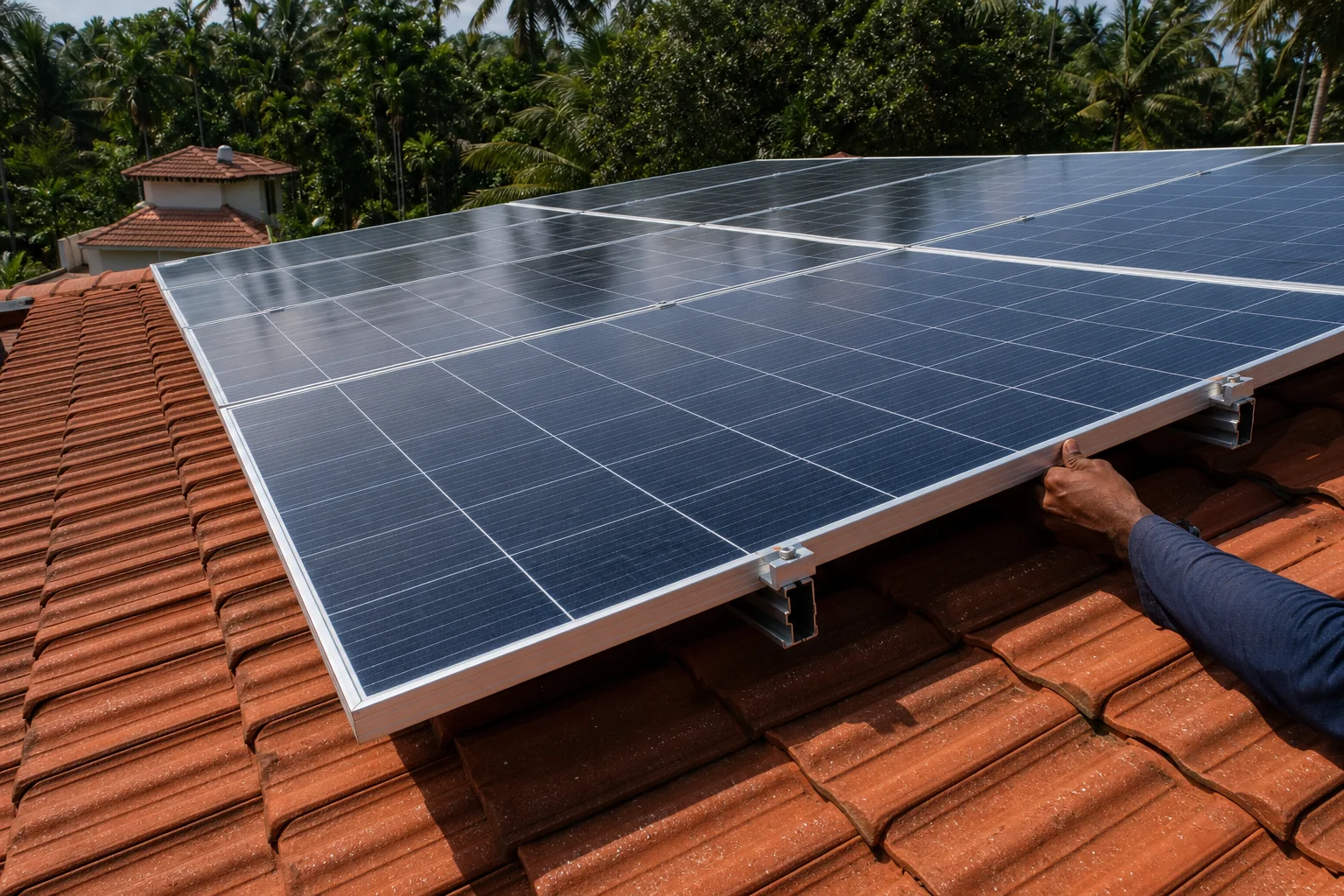
Panel count on paper means nothing if your roof can’t physically hold that many panels without shading losses. As a rule of thumb, budget 10 square meters of usable roof area per kW of system size, accounting for spacing, walkways, and tilt frames.
A 3kW system typically needs 28-32 sq. meters, while a 5kW system needs closer to 50-55 sq. meters. If your roof has water tanks, satellite dishes, or overhanging trees casting shadows for even part of the day, that usable area shrinks further. For a detailed breakdown of layout planning, see our guide on how much roof space is needed for a 5kW solar system, which walks through spacing rules in more depth. During a site visit, SOLAR CONNECT’s design team maps your exact roof using CAD tools and a PV simulation, so you don’t end up buying panels you can’t actually fit.
Sizing a system for a house in Thiruvananthapuram isn’t the same as sizing one for Jaipur or Pune. Kerala’s climate and grid conditions bring a few local factors into the calculation that homeowners elsewhere don’t need to worry about as much.
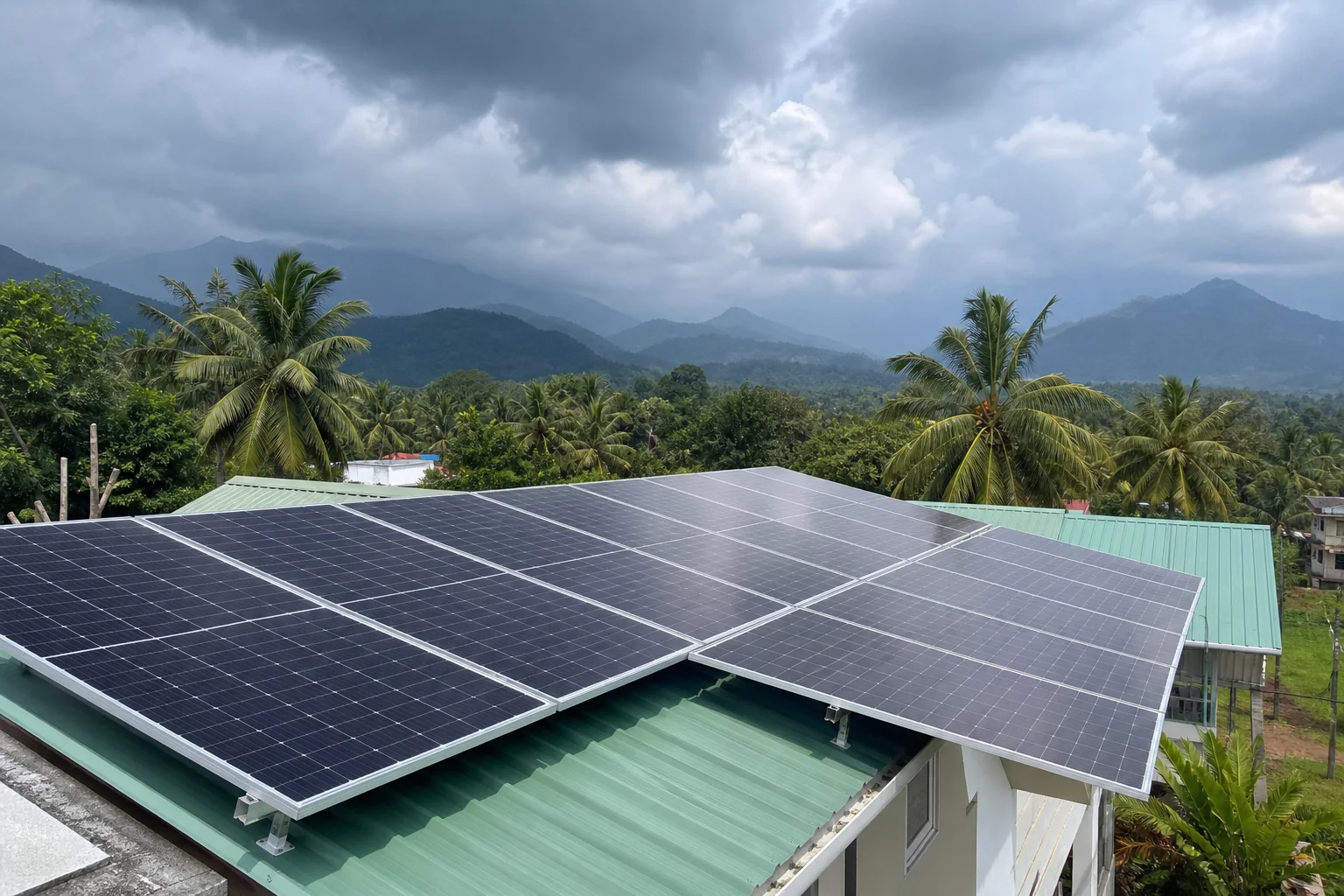
| System Size | Panel Count (375W) | Best Suited For | Roof Area Needed | AC Backup Capability |
|---|---|---|---|---|
| 3kW | 8 panels | Homes with lights, fans, fridge, TV, occasional AC use | ~28 sq. m | Limited, short AC runtime only |
| 4kW | 11 panels | Homes with daily AC use and a water pump | ~38 sq. m | Moderate, single AC most of the day |
| 5kW | 14 panels | Homes with 2 ACs, heavier daytime appliance load | ~48 sq. m | Good, covers 1-2 ACs comfortably |
Most 3-bedroom houses in Kerala land in the 3kW-4kW bracket unless the household runs multiple ACs or a heavy-duty pump. For a full cost breakdown at the popular 5kW tier, see our article on the 5kW solar system price breakdown in India.
Getting the panel count right is only half the job. The inverter capacity, wiring, net-metering configuration, and even panel orientation all affect how much of that solar generation you actually get to use. A poorly designed system with the “correct” number of panels can still leave you disappointed with your savings.
This is a common complaint we hear from homeowners who installed elsewhere: the panel count looked right on paper, but the bill barely moved. If that sounds like your situation, our article on why your electricity bill is still high after solar walks through the usual culprits, from shading to net-metering errors.
The safest approach is a proper site visit and load audit rather than a desktop estimate. SOLAR CONNECT’s engineers, working out of our Kazhakuttom and Kumarapuram offices, review your actual KSEB bills, inspect your roof, and run a PV simulation before recommending a final panel count and system size. You can start that process by requesting a Get Free Quote, or get a quick preliminary estimate using our Know Your Savings calculator first.
A 3kW system can run a 1-ton AC for a few hours during peak sunlight, but it won’t cover a full day of AC use plus your other household loads. If your home runs an AC daily, plan for at least a 4kW system.
Yes. Residential rooftop systems up to 3kW and beyond are eligible for MNRE’s PM Surya Ghar scheme, subject to current eligibility rules. Check our detailed breakdown of the MNRE subsidy eligibility criteria for rooftop solar before you apply, and SOLAR CONNECT’s team can handle the paperwork for you.
Budget roughly 38-40 square meters of unshaded roof space for a 4kW system using standard 375W panels. Higher-wattage panels reduce this requirement slightly since fewer panels are needed for the same output.
Shading reduces effective generation significantly, sometimes by 30% or more for the affected panels. A site survey will identify shaded zones so your installer can either avoid them or size the system slightly larger to compensate.
Yes. Monocrystalline panels, including WAAREE’s higher-wattage range, generate more power per panel, which means fewer panels for the same system size. Polycrystalline panels are usually cheaper per watt but need more roof area for the same output.
Guessing your panel count from a generic online chart can leave you with a system that’s undersized for your actual habits or too large for your roof. The only reliable way to know exactly how many solar panels your 3 bedroom house needs is a proper load audit and site visit. Speak to a Solar Expert at SOLAR CONNECT for a free assessment tailored to your KSEB bill, roof layout, and appliance usage, and get a system that actually matches your household, not an estimate. Speak to a Solar Expert today and get a written system recommendation before you commit to any installer.
Ask ten specific questions before you sign anything, and you'll know within minutes whether a solar installer is worth your rooftop. The questions to ask solar installer before signing contract...
My cousin in Kollam once got two solar quotes on the same day: one from a national brand's call centre, one from a Trivandrum-based crew that had already wired half his street. The loca...
A commercial energy audit before solar installation tells you exactly how much power your business actually uses, when it uses it, and where it leaks money, before anyone quotes you a panel cou...
© 2026 SOLAR CONNECT, All rights reserved. Developed by Crantia Technologies

